Showing posts with label Travel in Korea. Show all posts

Friday, January 07, 2011

Should I go to Korea?

This is a question I have been asked a lot in the last year or so. So I have decided to write up a document which I can send to multiple people to answer some of the usual questions about going to teach English in Korea.

So when people think of going to teach in Korea I think it’s generally for two reasons: money and adventure. And you’ll get plenty of both!

Let me address the money matter first. When we were there we earned around R14 000 a month (tax free for the first two years). It all depends on the exchange rate, but that gives you a rough idea. For example, at the moment an entry-level salary at a provincial public school in Korea is 2 100 000 Won which is around R12 800. If you work for the public school system in Korea (as opposed to private education academies called ‘Hagwon’ in Korea) you are guaranteed a return plane ticket home and accommodation costs will all be fully covered. I will discuss the pros and cons of public vs. private a bit later.

If you want to save money you can easily ‘send home’ around half your salary per month. Over the two years I was there I paid off most of my student loan – approximately R120 000 (that works out at around R5000 per month). This was pretty easy, I didn’t have to live an all too frugal life and I had enough money to travel internationally in all my long vacations: I went on budget backpacker trips to the Philippines, Cambodia, China, Mongolia and Russia. In addition we travelled around Korea a lot – we were out of our small town almost every weekend. So you can save a lot of money in Korea. You could save more than I did if you were more careful with spending i.e. eating only local food, not travelling as much etc.

Compared to pay in Taiwan and Japan (this is word of mouth), Korea pays best. The cost of living is slightly higher than in SA, but the salary is more than sufficient to cover that. Japan has much higher living expenses and salaries in Taiwan are slightly lower - from what I have heard.

As for adventure, well there’s plenty of it to be had as a teacher in Korea: at times too much. Teaching English in Korea is a huge challenge: you will be frustrated by the way Korean people and Korean beaurocracy do things almost on a daily basis. The Asian approach is incredibly different to the western approach: in almost every aspect of life. You will learn how to cope with this eventually but it is something which all westerners working in Korea struggle with a lot. Be prepared to be very frustrated. The best advice is to ‘go with the flow’ and just accept that things are done differently but that is something that just comes with time. And remember you’re earning good money.

Working in Korea is an opportunity to explore and get to know an entirely different culture. It is clichéd, but clichés are usually true: you WILL get to know Korean culture very well: the good and the bad. Koreans are incredibly kind, generous and hospitable people. They are proud of their country and their culture, and many go out of their way to ensure that we have a good time there. You will have an amazing culinary experience too: most Korean food is excellent – some is strange and seems unpalatable but your senses will have a feast! Koreans drink a lot too, so be prepared to be coerced into a lot of soju and beer consumption :)

Korean students are generally well-behaved. It takes a while to get used to teaching them – they are intimidated and often scared of foreigners so it takes time to win them over and get them to warm to you. But you will soon find out what makes them laugh and how to get their attention. They are a pleasure to teach – mostly. As in any classroom there are a few ‘rotten eggs’ but the good eggs more than make up for them.

I really miss my students so much: they are the sunshine in a sometimes frustrating and exhausting job. It’s for them that I did it and giving to them makes them give back tenfold. If you make an effort to prepare fun, relevant and stimulating materials and activities they will reward you with their special smiles, enthusiasm and love. They are really affectionate and it always amazed me how much warmth and love they had for me despite how very worn-out they were from working so hard. Most Korean students over the age of 12 have a 12-14 hour school day. It is intense, but despite that, after the first 6 months of hit and misses, my classes were almost always fun and the students did their best to participate.

Private or public school? This is an important question. I worked for a public school i.e. I was a government employee. Foreign teachers in the public school system are administrated by an organisation called EPIK: English Program in Korea (www.epik.go.kr). If you are employed by EPIK you will not have any major hitches. You may have small problems with your school like discrepancies about vacation dates, housing etc. BUT in the greater scheme of things you will not be messed around. You will be paid regularly and correctly, you will be on national health insurance and pay a pension, you will be provided with housing and you will be guaranteed a return air ticket. It’s a sure thing.

This is not the same when working for a Hagwon (private education academy run as a business). The horror stories one hears of teachers not being paid, having no health insurance, being fired for no reason etc. etc. are all from the Hagwons (this applied to Korea as well as Japan, Taiwan etc.) Not all Hagwons are bad, in fact the majority of people I knew in Korea working for Hagwons had no problems at all, but there is always the chance that something could go wrong, so I always recommend people to apply for public school jobs with EPIK.

Placing – whether you choose to live in a city or in a rural area is also an important question to consider when applying to teach in Korea. The pay in the provincial i.e. rural areas is slightly higher. I suppose this is an incentive to entice foreigners into rural areas as life in cities is a lot easier for expats. The other advantage of working provincially is that life is generally cheaper – most people I know working in provincial areas can walk/bike to school and that saves on costs. There is a lot less ‘on offer’ provincially for foreigners and so one does end up spending less money. For example if you lived in a city and you craved decent pizza you could easily head off to Pizza Hut or whatever. There are obviously a lot more amenities in the city and that always increases living costs.

However, if you really want to have a lot of parties, have access to western food, English bookstores etc, then the city is better. There are always a lot more foreigners in the cities and it is a lot easier to meet people, to get around etc. Life in the provincial areas is harder: no-one speaks English (sometimes it’s even difficult to communicate with English teachers) and there are a lot less foreigners to connect with (although this is changing fast as Korea spends more and more on employing foreign teachers). Rural people are still not accustomed to foreigners and you will be stared at and watched s lot. That is a fact of rural life everywhere though. Conversely, you will learn so much more about Korean culture and people living in the provincial areas. You will meet warmer, friendlier people and feel more part of a community. It’s up to you where your priorities lie.

When applying for EPIK you will be asked whether you want to have a city or provincial job so bear this in mind.

I have done my best to address some of the most common questions I am asked by people interested in teaching in Korea. In conclusion I always say: go for it!

It is an incredibly challenging experience but you will grow so much as a person. You will learn so much about yourself, your priorities and what you want in life. Living in Korea will open your mind to a whole new way of seeing things – will make you realise how huge and diverse the world is. It’s an incredible opportunity and we as English-speaking, well-educated South Africans are truly fortunate to have such an opportunity.


So… once you’ve decided you want to go, how should you apply?

Here are some ideas:

We went over with an agency called Teach Korea. They are based in Cape Town and are pretty good. I have heard though that lately they have been pretty bad about not communicating with clients and keeping people waiting. I think it's because they just take on too many clients. Anyway, the one main advantage with them is that they are South African and can help with visas, education dept. docs etc. and they know the system here very well - I'd say that 99% of the time they get people there but you'll probably tear your hair out waiting and hoping it all works out.
So try www.teachkorea.co.za - we dealt with the owner Cliff.

Alternative 2 is that you contact Footprints Recruiting. They are a Canadian company but I have heard of quite a few South Africans who have successfully gone through them. The problem is that you’ll have to make a few international calls and that they may not be much help with local government departments with respect to documents etc. But give them a try:
http://www.footprintsrecruiting.com/

The third option is to go through the Korean government English teaching programme directly. It's called EPIK and if you apply for public school jobs through Teach Korea or Footprints you will end up working through EPIK anyway. The hard part of doing it direct through them is that you have to deal with visas, education dept etc on your own which takes a bit more guts and perseverance. But it is possible. www.epik.go.kr

Sunday, September 26, 2010

Jeju for the Summer!

After much deliberating we finally decided to got to Jeju island for a few days over the summer vacation. This was quite a tough decision as we've been trying to save as much money as possible since we're going on the Trans-mongolian train in October and that's going to cost us a packet. But weeks of of spending our summer days in air-conditioned rooms made me decide we HAD TO get out ad at least try to spend some time outdoors and see the sun - in a place where we would at least be able to swim to cool down. Plus just getting out of Sangju for a few days would do us a world of good! We were also really lucky in that out friends, James and Barbara, who live and teach on Jeju, offered us their flat for the 4-5 days we were there - this was the final thing which made us decide to go.

Jeju is the largest Korean island - it is the NUMBER ONE holiday destination for almost every Korean person. Most Koreans would probbaly rather visit Jeju than an international destination - it has some 'nicknames' e.g. "The Hawaii of Korea" etc which demonstrate its popularity. It is indeed a beautiful island - but to be fair, one cannot really compare it to Hawaii or other tropical island paradises. It is more tropical than the mainland, has milder winters and a very green and pretty landscape. Jeju has grown into a veritable 'Tourist island' for Koreans - I would hazard a guess that about 80% of the islands' revenue comes from tourism: it is littered with hotels, guesthouses and tourist attractions: some natural but mostly man-made and uniquely suited to Korean tourists: Museums, shows, museums, parks, museums, art galleries, museums, etc etc. You get the idea - the 'places to visit and things to do' list one could make for Jeju would make a fat book.

Jules and I avoided all those commercialised not-so-relaxing options and just CHILLED. The weather helped a lot - we had 3 almost solid days of rain and drizzle which meant we stayed holed up in James and Barbara's apartment reading, watching movies and just chilling. The rainy-beach-holiday kind of vibe that is so good for the soul. We had really hoped to do some diving on Jeju, but alas, the weather was awful and the sea in no state for us to immerse ourselves in it.

We did, however climb Mount Halla - South Korea's highest mountain and an ancient volcanic crater. Climbing Mount Halla (Hallasan in Korean) is a bit of a pilgrimage for most Koreans - living in such a mountainous country, Koreans have a strong, often spiritual, connection to mountains. Mt. Baekdu is the highest mountain in the Korean peninsula but is now pretty much inaccessible to all South Koreans as it is in North Korea, and so they all want to climb Mount Halla - which comes a measly second. It isn't very high at all (1950m) - compared to the 2744 m of Baekdusan, and is easily climbed in a day, as long as one is moderately fit. So, we climbed with with hundreds of other people! The climb up and down took us about 9 hours - it is quite steep, and is about 19km in total. Almost a third of the climb is on boardwalks or stairs which makes it much easier than it would be otherwise. It's an interesting mountain to climb - it has 4 distinct vegetation strata and the geology is very different to all the other mountains we've climbed on the mainland. I really enjoyed the climb - it was quite misty at the top so we couldn't see the sea which one usually can but nonetheless the view was pretty awesome - there is a beautiful clear crater lake in the top of the mountain and the base of the crater is so green!

On our other 'sun-day' we went to a Herb Farm - Jeju Herb Dongsa (yup, one 'tourist' trap which caught us!) where we ate giant plate-sized hamburgers (actually just a giant round ham sandwich) and enjoyed walking around the pretty gardens and taking pictures. In the afternoon we headed down to Pyoseon beach - I was really keen to swim, and I did take a dip, but the lifeguards were overbearing and I was just not ready to srum it in the tiny 'safe swimming' zone into which everyone was jammed so we just lay on the grassy banks above the beach and relaxed.

We also managed to meet up with some friends from the mainland (Joe, Clint and Natalie) and had a meal of traditional Jeju island black pork together - turns out it wasn't 100% good pork as 3 out of 5 of us had an awful bout of food poisoning within 48 hours of consuming the damn pig! Below are some photos of our Jeju holiday. I'm so glad we went - it really was relaxing and great to just have a change of scenery and be on holiday!

We travelled the cheap way to Jeju - by train from Sangju to Mokpo which took about 6 hours, and then another 5 hours by ferry from Mokpo to Jeju. A bit tiring but we had time on our side so it wasn't too bad.

We travelled 'stowage class' on the ferry - all in a big room together!

On the way there we were in a slightly smaller room - 30 people.

Fish trays in Mokpo

Boats in the afternoon - Mokpo city.

Cicadas in the garden at the herb farm - wow, there were so many of them, and also so many beautiful butterflies!

Chair swing! So Romaaaantic - typical Jeju!

Our black pig dinner...

Seogwipo Harbour on Jeju.

Kids playing, yes, really PLAYING, in a small tidal pool in Seogwipo.

We weren't the only ones hiking to the top of Mount Halla!

The crater lake on Hallasan. So pretty!

Hallasan!

Some mossy forest - this bit was very moist with water oozing out of the ground.

Drier pine forests lower down the mountain.

Our route up the mountain - as everything in Korea is - very controlled and orderly. No alternate routes, just straight to the top!

Strange conifers near the top of the mountain.

Broad-leaf forest similar to that which we see a lot of on the Korean mainland.

On the way down.

Hallasan Nabi!
(Nabi=Butterfly in Korean)

Friday, April 30, 2010

I love my MOM and DAD!


Families group photo (+ David) at Gyeongbokgung Palace in Seoul.

IT'S OFFICIAL: I have the most wonderful parents ever. I mean, they came all the way to KOREA to visit me! They could have gone to the Serengeti, the Amazon, London, any other possibly more 'appealing' destination. But No, they came to Korea! Thank you Mom and Dad, for such a truly generous and loving gesture. I'm so blessed!

Mom and Dad and Gordon and Kay (Julian's parents) came to visit us in South Korea for 2 weeks in March-April.

It was really special to see them again and to show them 'our places'. By the sounds of it, they had a wonderful time. It was a whirlwind trip, and pretty exhausting for Jules and I, as we'd have our normal 8 hour school day and then come home in the evenings to our eagerly waiting parents, bless them! Having them here made me realise all over again how helpless one is when one first arrives in Korea and, actually, how traveller-unfriendly Korea is - well, from a language perspective at least!

Mom and Dad were in Sangju for two weeks, and Gordon and Kay were here for a week and in Seocheon, with Simon for a week. At the weekends we tried to arrange trips for us all to be together. We basically spent our two weekends all together in Seoul, being real tourists. An adventure of note: leading 7 people through the massive metropolis of Seoul!

On Mom and Dad's last weekend here we hired a car, and Jules and I went to Gunsan with them. There is an estuary there which has been proclaimed a sanctuary for migratory birds and we had agreat time bird-watching there and just bumbling along country roads exploring and enjoying the freedom and flexibity of having 'our own wheels.'

I'll let the photos tell the rest of the story.
(Mostly my photos and also some from the Barker's camera).


At a 'Sujebi' (dough flakes soup) restaurant in Insadong, Seoul.

The 'gents' reading their newspapers while we waited an hour and a half at the bus terminal in Seoul to catch our bus back to Sangju.

Our fancy car for the weekend in Gunsan. Not bad for a 'first car' eh?

In Buyeo: we had a lovely walk through the forest.

Dad at it: with as many accessories as he could manage around his neck: binoculars, camera, compass, sunglasses....that compass DID come in useful! As did his 'built-in' compass: like the time when the taxi driver took a wrong turn on Seoul and only noticed after Dad had...


Jules 'getting lost' in the VAAAAST reed beds near Seocheon, one of those hyped-up tourist detsinations in Korea which is a huge let down once you get there!

Our picnic breakfast at the reed beds.

Dad cooking up a storm in our apartment. Thanks Dad!

With Mom on a boat cruise on the Han River. Mom made me feel so very loved on this trip: just always telling me how wonderful to be with us. And just being so relaxed about everything. Thanks Mom, for being such a gracious guest!


Dinner with the Barkers and Julian's co-teachers.


All of us at Incheon International Airport.

Birdwatching at the Geum estuary in Gunsan.

Missing INGI! The three of us at Gyeongbokgung Palace.

An exciting Hike: Lunar New Year, snow, darkness, COLD!

The hike we did on Lunar New Years is high up there with the most exciting and memorable of my experiences in Korea. It is an old Korean belief that if one watches the sun rise from a mountain peak on Lunar New Year, the year will be a lucky one!

Lunar New Year is usually a long weekend in Korea, and one is advised not to travel long distances as the roads and trains are chock-a-block with people travelling home across the country to be with their families. So many Koreans work away from their families, and national holidays are often the only opportunities for them to see each other, especially as most people work weekends as well.

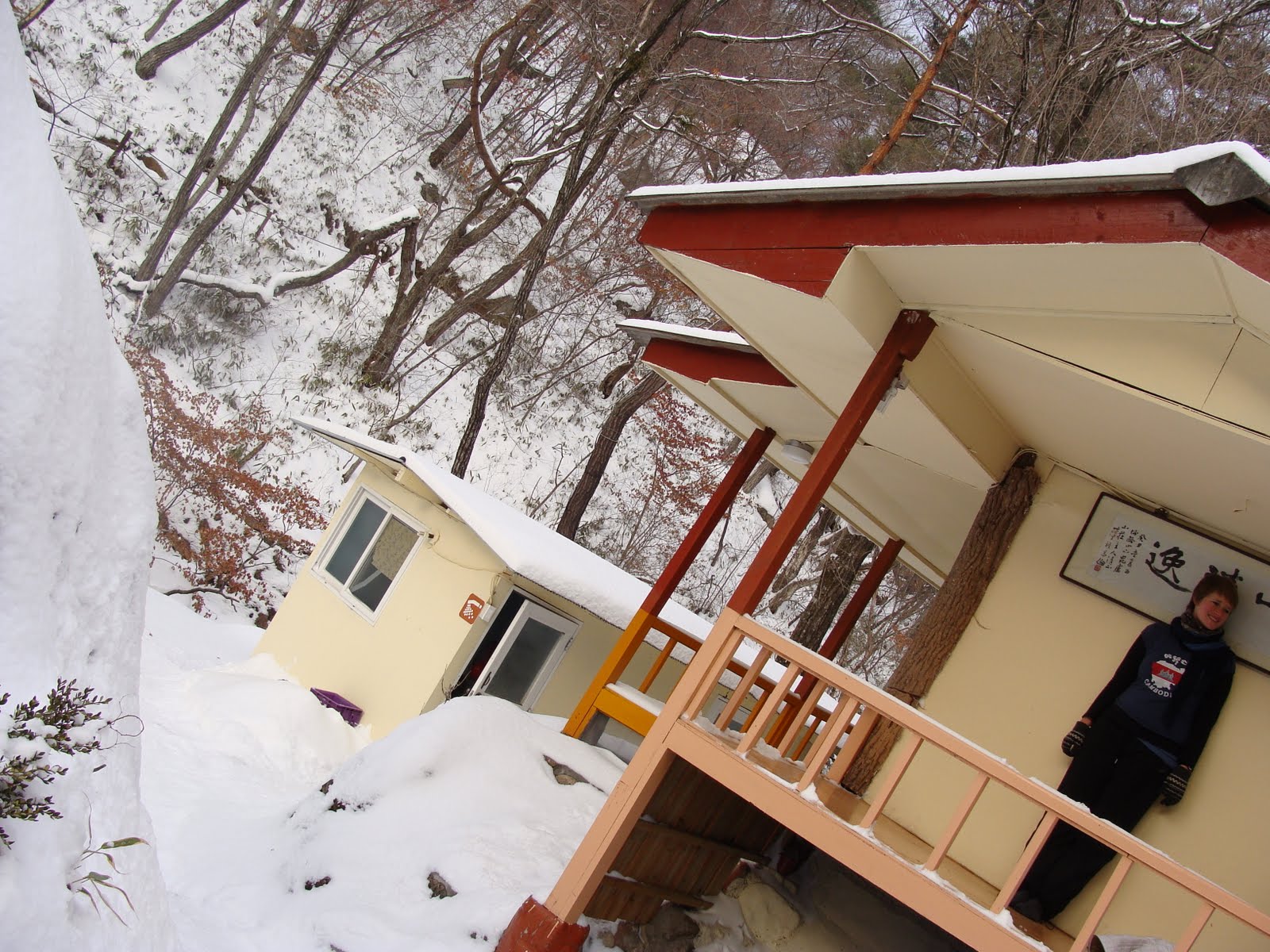
So we decided to plan some 'local fun' for ourselves. There is a National Park near Sangju, Songnisan National Park, which takes just over an hour to get to. We headed over there and spent the night in a fantastic little 'mountain hut' in the park - 'Birosanjang'. It's one of my favourite places in Korea: it's really rustic, with long drops and tiny little Korean style 'ondol' (heated floor, sleep on a mat) rooms and genuine hospitality. One is surrounded by mountains and forests, and the only sounds are birds and the gushing river. We had a hearty Korean dinner and then an early night.

We woke up at 4 am and by 4:30 we were ready to go. It was pitch dark and snowy all around: it was not snowing at the time, which is fortunate, but there had been a good snowfall during the week. The plan was to hike to the top of the nearest mountain peak, from where we'd watch the sunrise. It took us, as planned, just over two hours. Walking up that mountain was so peaceful: the forest was as still as only a forest covered in snow can be, and there was not a soul to be seen. So quiet.

It was, by far, the coldest, darkest hike I've ever done! I'm willing to be the temperatures on the way up were hovering between -3 and -5 degrees celsius. Once we were up on the exposed peak, the temperature dropped dramatically, I think it may even have reached -10 degrees. Incredibly cold! It was so cold, in fact, that we couldn't stay up for the sunset, we saw the sky redden in the east, it was just pink enough to confirm that indeed that day, the sun would rise, and then we were off, down the other side of the mountain. We have been skiing in Korea, but the cold we experienced up there on that mountain was by far the coldest I have been in my life! But it was a thrilling, unforgettable adventure with a great bunch of people!

On our way down again, with a dear friend of mine, Lina, the ice angel! She is an outdoor enthusiast of note, a snowboard instructor and a lovely lady!

I told you it was pink! The sun did rise, we just didn't see it!

'Munjangdae': the peak we scaled.

On top! So wrapped up! So cold! The flecks of snow in the picture were being blown off the peak by the strong, cooold wind.

'Birosanjang': one of my favourite places in Korea

We visited Beopjusa temple before checking into our mountain hut, it looked lovely under snow!

Us on the snow!

Go Team!

Monday, December 28, 2009

Snowy Skiing at Muju Resort

Two weekends ago we went skiing at Muju resort. Muju Ski Resort os one of the biggest in Korea and is about 2 hours from here by car.

Arranging public transport to get to Muju was a bit of a nightmare - we were going to take a shuttle bus organised by the resort, but then it was cancelled at the last minute as they didn't get enough bookings. So then we were going to have to take two trains, a bus and a very expensive taxi to get to the resort. Our dear friend Seong-suk then came up with the brilliant idea of hiring a van (=mini bus). Her husband arranged a great deal for us and for W200 000 for the weekend it was very much affordable. I was the designated driver - the only one with an international drivers' licence - and fortunately it all went very well. Thanks go to Dan, a UK friend of ours, for taking over the tricky snow-driving!


We had a fabulous time at Muju: the weather was perfectly wintery! It snowed most of the time we were there - this was of course accompanied by very cold temperatures: it was around -7 degrees C most of the time, and at one point my eyelashes even began freezing shut (scary!!) but it was great for skiing. I am still not a very good skiier but I really enjoyed going down the slopes at my own pace, and by now I am relatively comfortable even going down the internediate slopes which is a real personal achievement!

My skills were really put to the test on Sunday afternoon when we decided to all go down the longest slope at Muju together. It is called 'The Silk Route' and starts high up in the mountains. When we got out of the gondola (=small cable car) at the top it was very misty and windy. We had lunch at the restaurant on top and then headed off to the slopes: well, the conditions were rather scary. By now the wind was howling and the mist and snow coming down so think one couldn't see more than about 20m ahead. This all on a relatively steep slope which had turned to ice. The wind had blown all the surface snow off the slope and it was treacherous and very, very slippery. Scary on smooth skis which are made for snow not ice!

Anyway, we took it really slow, and Lina, our 'Ice Angel' helped us avoid the worst of the ice. She is an experienced snow-boarder and it was very comforting having here there with us. The scary conditions lasted for about 2km of the slope, and as we got lower down it cleared a bit but it was certainly a rather nerve-racking experience - bonding for sure!

Our group for the weekend was as follows: Simon, Dan, Melissa, Lina, Julian and Jess. Lina is from the nearby town of Gimcheon and the others are all from Sangju. A combo of 2 Poms, 2 Americans and 2 South Africans. We had a fantastic time together and really look forward to another ski trip in February when we're back from Cambodia. Enjoy the photos!

Beautiful Muju Ski Resort: the resort is designed in a kind of Alpine Style - very well done actually!

An ice-cream in the snow at minus 7, I just had to!

The slopes! This was a beginner slope - one which I spent most of my weekend going down, just getting into it again and not putting too much pressure on myself :)

Who's who??

Go Team! from left to right: Simon, Melissa, Dan, Lina, Julian, Jess.

Cleaning the snow off the car, as more was falling! We really loved being in the snow, it is still such a novelty for us!